
Allocation Game: The regional growth forecasts in the CAMPO 2045 Regional Transportation Plan
Every five years, CAMPO adopts growth forecasts that quietly drive transportation spending, school planning, traffic studies, and county debt across the Austin region. We tracked how the 2045 forecasts were made and found that the second draft added 391,555 future residents back to Williamson County, above what the region’s own UrbanSim modeling predicted, without public discussion. The 2040 forecasts had already overestimated suburban growth and underestimated growth in Travis County. We recommend an open process and a scenario planning system that tests every major investment against at least two reasonable growth futures.
Equitable Growth: Incorporating Best Practices for Equitable Transit-Oriented Development into Austin’s sustainable growth policies
Austin is about to decide on its first high capacity transit lines in a generation, and a lot of people are going to want to live within walking distance of the stations. Building on Growing Weirder, a summer of interviews with practitioners who run equitable transit-oriented development programs across the country, and a charrette in Austin, we recommend three steps: fund an equitable growth strategy for the Orange and Blue Line corridors before the 2020 vote, create an Equitable Transit-Oriented Communities Commission, and build an Equitable ATX Fund to finance affordable homes near transit.
Growing Weirder: EquitableATX Development Fund, A Proposal for Neighborhood Powered ETOD Fund(s)
Austin is in need of a multiplicity of strategies to address growing affordability and environmental crises. If we fail to responsibly plan for growth, low income communities and people of color will be disproportionately burdened with costs to their quality of life. Building off of successful models throughout the nation, we propose the establishment of an Equitable Transit-Oriented Development Fund to take advantage of the opportunity to make meaningful progress towards an Equitable Austin.
Growing Weirder: Housing + Transportation Affordability by Urban Form Across the Austin Region
The affordability of a location is normally calculated with only housing costs. However, transportation is the second largest household expense. Throughout Texas, housing and transportation cost around half of typical local incomes. We divided Austin into urban, sub-urban, and rural areas based on population density and compared costs of housing and transportation in these areas as a percentage of typical median income. Bucking conventional wisdom, we found that urban areas of Austin are the most affordable.
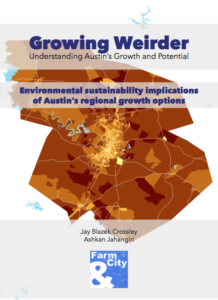
Growing Weirder: Environmental sustainability implications of Austin’s regional growth options
Building outwards instead of upwards is an environmentally disastrous choice. Austin residents of denser areas are responsible for drastically less impervious surface per capita, the financial and environmental footprint of municipal infrastructure is more efficient for compact, connected development, and the redevelopment of wasteful land use within the city means the preservation of hundreds of square miles of Texas pastures, forest, and countryside.
Texas Transportation Equity Assessment: Texas Sunset Commission Edition
We catalogued the 203 voting members of the boards that run the nine largest Metropolitan Planning Organizations in Texas, home to three in four Texans, and found that only 31 are women and that white men hold far more seats than their share of the population, especially in Houston and Dallas-Fort Worth. The report also looks at the Texas Transportation Commission and TxDOT leadership, and proposes remedies ranging from proportional representation at MPOs to citizens advisory committees and multimodal performance metrics.
Texas Transportation Equity Assessment: Special Report on Representation at CAMPO
In 2016, CAMPO considered proposals that would give Travis County, home to 57 percent of the region’s people and 74 percent of its jobs, an even smaller share of seats on its Technical Advisory Committee. This special report looks at who sits on CAMPO’s Transportation Policy Board and Technical Advisory Committee and finds Travis County residents, women, and people of color all underrepresented, with six people of color among the 50 members. It proposes a one person, one vote alternative and a citizens advisory committee elected from districts of 100,000 people.