As Farm&City has done in past years, I want to take a moment to highlight meaningful policy improvements and moments of progress across the state — especially in transportation, urban planning, sustainability, and equity. Even in a year of transition and upheaval, some good things still happened in Texas public policy.
These changes did not happen by accident. Some reflect years of Farm&City work gradually coming to fruition, while others were shaped more directly by actions taken this year.
While Farm&City paused operationally in the spring of 2025, with no paid staff, real public policy progress continued. During that time, I continued working as a volunteer — doing media work, giving presentations, and showing up in public meetings and policy conversations where Farm&City could still play a constructive role.
Here are ten good things that Farm&City helped make happen this year. Some of it was visible. Some of it was quiet. Much of it was collaborative. None of it was inevitable.
1. We’ve Got a Draft TxDOT Statewide Transit Plan
The Texas Department of Transportation released a draft statewide multimodal transit plan following the first truly meaningful statewide effort to assess transit needs across rural, small urban, and metropolitan Texas. This is an important early step — not a solution yet, but the beginning of a long-overdue conversation about what sound, equitable transit policy could look like in a rapidly growing state.
Developing a statewide understanding of transit needs has been a Farm&City priority since we helped launch the Texas Friends of Transit coalition in 2017. Doing important work building transit advocacy statewide, this coalition asked the legislature to take a much broader approach to public transportation. That work laid important groundwork for later efforts, including coordinated advocacy during the 2023 legislative session to encourage the state to formally study public transportation needs across all regions of Texas — rural areas, small cities, and major metropolitan areas alike. While no legislator ultimately filed the proposed budget rider, the conversations it sparked with lawmakers and TxDOT leadership helped clarify what was missing and why it mattered.
With the release of the draft plan this year, I focused on reading, analyzing, and responding to the document, and on helping media and partner organizations understand both what TxDOT has accomplished and where significant gaps remain. I submitted formal comments (and encouraged others to do the same) wherein I emphasized that the plan must grapple honestly with the reality that Texas’s largest metro transit systems carry the vast majority of riders while receiving no state operating support, and that real progress will require a clear vision for abundant modal freedom and substantially increased transit funding statewide.
2. The People of Texas Saved Texas Transit — for Now
This legislative session, we played a role in defending Texas transit, including Austin’s Project Connect light rail and bus rapid transit plans, equitable transit-oriented development, and DART funding for the people of Dallas and twelve other cities.
Several bills sought to override Austin voters’ 2020 decision to dedicate local funding to high-quality, frequent public transportation. I joined a diverse coalition of organizations and leaders to stop those efforts and preserve Austin’s ability to build the transit system its residents voted for. At the same time, elected officials from several suburban cities in the Dallas region attempted to overturn their own voters’ decisions to dedicate sales tax revenue to DART, threatening major cuts to regional transit service.
In both cases, a broad group of advocates, local leaders, and organizations worked together to prevent severe defunding and policy rollback. Together, these efforts saved Texas transit — at least for now.
3. Innovative Local Road–Railroad Crossing Safety Funding was Added at Twice the Proposed Level
For the first time, the Texas Legislature added state funding specifically to address safety issues at railroad crossings on local roads. Over the course of the session, that funding was doubled from roughly $175 million in the original TxDOT appropriations request to $350 million by the end of the process.
I engaged early during TxDOT’s appropriations request hearing before the Senate Committee on Transportation. Following positive feedback, I directly pressed agency leadership to increase the funding request. I’m proud to have been part of that push, alongside much larger and more powerful voices that ultimately helped make this significant investment in local safety possible.
4. Texas Media Coverage of Traffic Crashes is Meaningful and Useful
In the Houston Chronicle, Dug Begley continued his in-depth reporting on traffic deaths and serious injuries in the Houston region, documenting both long-term trends and how the city continues to fare worse than the rest of Texas. His recent article shows that while serious injuries and deaths are on pace to decline statewide in 2025, the drop in Houston lags behind, following several of the deadliest years on record.
Throughout this coverage — as I do with reporters across the state — I participated as a nonprofit advocacy voice, helped to clarify what the data actually shows and explained the real-world consequences of policy decisions. Begley’s reporting helped elevate the urgency of traffic safety reform in Texas, and as he quoted me in the paper saying that “too many families in Houston have lost a loved one to a violent, unexpected event just trying to use the transportation system.”
This reporting fits within a longer arc of Farm&City media work focused on safety, accountability, and the everyday human consequences of how Texas plans, funds, and designs its transportation system. A full list of Farm&City media coverage from the year appears at the bottom of this post.
5. Profound Progress on Land Use Reform, with Reduced Parking Mandates in Dallas and Major Reform at the Legislature
Years of Farm&City work building both conservative and progressive cases for zoning reform paid off this year — even as many other leaders and organizations can rightly say the same. We had a great experience supporting work with the Dallas Housing Coalition on framing, advocacy, meetings, and strategy. This young coalition successfully shepherded significant reforms that reduced Dallas parking mandates across the board.
At the Texas Legislature, Texans for Reasonable Solutions and Texans for Housing led a strong, broad coalition that advanced meaningful land use reform. I was able to participate in some meetings, support lobbying days, and work with specific legislators and staff, though Farm&City did not actively work these bills. Even so, this was exactly the kind of outcome we hoped to help enable when we co-hosted YIMBYtown 2024 — building the case that growing affordability needs across the state make policy change inevitable, with plenty of room for solutions from across the political spectrum.
I am personally most thankful that HB 24, led by Representative Angelia Orr and Senator Bryan Hughes, made it through the Legislature and was signed by Governor Greg Abbott. This bill repeals a Jim Crow–era law that gave property owners an exclusive veto over the democratic process. That anti-democratic and unfair veto was used for decades to block reforms that Texas mayors and city councils can now pursue, allowing the market to provide more affordable options for Texans to live how and where they want.
6. Serious Engagement on Automated Vehicle Policy at the Texas Legislature
We were one of the few nonprofits working statewide on automated vehicle policy this session, engaging legislators and key staff as Texas finalized a comprehensive regulatory framework for autonomous vehicles. Our work reflected a clear view: automated vehicles already outperform human drivers in many safety-critical ways, and public policy should help speed their deployment in ways that deliver real, measurable benefits for Texans.
Rather than approaching AVs as a hypothetical or a risk to be contained, we worked to ensure they are integrated into Texas’s transportation system as a safety-forward, access-expanding technology. We emphasized their potential to reduce deaths and serious injuries, increase independence for people with disabilities and older adults, and provide new mobility options for people who cannot or should not drive — all within a Safe Systems approach that prioritizes prevention over punishment.
Thanks to the work of Senator Brent Hagenbuch and Representative Pat Curry on SB 2807, Texas now has a modern legal framework for autonomous vehicles. The work ahead is about implementation and outcomes: how these policies perform in practice, how safety and accessibility are delivered on real streets, and whether AV deployment actually advances the public goals it promises. We were glad to help shape a policy environment that treats automated vehicles not as a novelty, but as a serious and lasting part of Texas’s transportation future.
7. Safe Streets Progress Across the State, Including in the Panhandle
Thanks to support from the Tecovas Foundation, we had the privilege of working in the Amarillo region this year. A significant portion of that work focused on supporting city staff and local leaders as they developed and adopted a Safe Streets and Roads for All plan. Under the leadership of Mayor Cole Stanley, the Amarillo City Council adopted that plan this spring and began the hard work of identifying and funding investments that will save people’s lives and limbs — whether they are driving, walking, biking, or using transit in Amarillo.
Communities across Texas are seeing similar benefits from the federal Safe Streets and Roads for All program. With the FY2025 awards announced just last week, total federal investment in Texas through this IIJA program has grown to more than $239 million, supporting hundreds of cities, counties, and regional governments across the state.
For two years, TxDOT funded Farm&City’s work to help local governments across Texas understand the fundamentals of Vision Zero, safe multimodal design, speed management, Complete Streets, and how to apply for these federal grants. Traveling across the state to work with public servants on making their streets safer was some of the most rewarding — and genuinely fun — work we’ve ever done.
8. Several Transportation Anti-safety Bills Failed at the Legislature
This session, a larger-than-usual set of bills was filed by several legislators seeking to block or outlaw proven street safety tools used by local governments to reduce traffic deaths. None of those bills ultimately became law. Preventing harm required real work from Farm&City, and we used the last remaining funding we had for Katrina Miller and me to show up and stand up for safety. That effort mattered.
I testified in the Texas House Committee on Transportation against HB 4348 by Representative Giovanni Capriglione, a bill premised on the idea that cities are endangering motorists by reallocating street space to buses, bicycles, and pedestrians. The bill analysis framed local safety projects as an attack on drivers, despite clear evidence that roadway restriping and so-called “road diets” reduce crashes, improve emergency response times, and save lives for people using streets in all modes — including while driving.
At the hearing, Katrina Miller and I emphasized that HB 4348 would have stripped Texas communities of the freedom to make basic, data-driven safety improvements on their own streets, overriding decisions supported by police, engineers, first responders, and local elected officials. The bill would also have punished cities pursuing street safety by threatening housing funding during a housing crisis — creating new problems without solving any real ones.
The bill advanced out of committee but ultimately died in Calendars. Stopping it was a small but genuinely glorious victory, and a reminder that showing up — with facts, lived experience, and respect for public servants doing hard work — still matters.
9. A Quiet but Meaningful TxDOT Design Shift to Transect-based Design
The Texas Department of Transportation quietly released an updated Roadway Design Manual in November 2024. Almost no one seems to have noticed — including me until I noticed it this summer — but the changes include a meaningful shift in how the agency approaches street design, particularly in Texas’s most urban places.
For the first time, the manual clearly recognizes a dense urban or urban core context where streets are expected to function differently than rural highways or suburban arterials. In these places, the goal is not high-speed travel, but safe, comfortable access for everyone — including people walking, biking, using transit, delivering goods, and driving cars and trucks. This reflects a quiet move toward a more transect-based approach, where design responds to place rather than applying one set of assumptions everywhere.
These changes align closely with what I urged TxDOT leadership to pursue in meetings back in 2018 with then-CEO James Bass and his senior team, including adopting transect-based design standards similar to the innovative context-sensitive work pioneered by the Florida Department of Transportation. At the time, I argued that Texas needed clearer recognition that design speed, lane width, frontage roads, slip lanes, and other familiar features carry real safety consequences — and that different places require different design choices.
The updated manual does not solve these challenges outright, but it creates more room for engineers and local governments to design streets that support slower speeds, safer crossings, and genuinely walkable urban places — without excluding vehicles or commerce.
There was no press release and no victory lap. But this is often how durable policy change happens: quietly, incrementally, and years after the case for change is first made.
10. I Asked Senator Ted Cruz to Support Efforts to Save Lives on Texas Streets and Roads
I traveled to Washington, DC for the Equitable Transportation Fund’s Voices for Transportation convening, where frontline advocates from across the country met with members of Congress and their staff to discuss the next federal transportation reauthorization. The convening focused on sharpening shared strategy, strengthening relationships, and grounding federal policy debates in real, local safety outcomes.
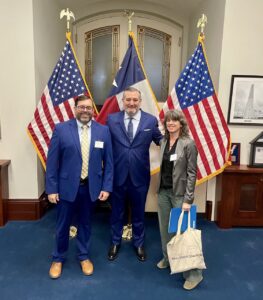
Along with Katy Atkiss of the Texas Streets Coalition, I had a brief opportunity to greet Senator Ted Cruz and then spent meaningful time with his committee staff discussing traffic safety, local control, and the importance of continuing—and expanding—the Safe Streets and Roads for All program. While the Senator interaction itself was short, the staff conversation was substantive, engaged, and grounded in data and Texas-specific examples.
In my remarks and follow-up discussion, I emphasized a simple but urgent reality: on an average day, eleven Texans die on our streets and roads, most of them while driving. I shared how Texas has already taken important steps—such as the Texas Transportation Commission’s adoption of a Safe Systems approach and sustained state investment in safety projects—and how federal programs like Safe Streets and Roads for All are now enabling cities, rural counties, and regions across Texas to accelerate that work.
We talked about why safety has emerged as a rare area of bipartisan agreement, how local governments are using federal grants to implement proven, data-driven solutions, and why protecting direct local access to safety funding matters—especially in a state as large and diverse as Texas. I also shared examples from Amarillo, Fort Worth, and across the state showing how these investments translate into lives saved, injuries prevented, and communities made safer for everyone, whether they are driving, walking, biking, or riding transit.
None of these wins stand alone. All of them are fragile. And all of them point to the same underlying truth: sustained, professional, well-coordinated public policy advocacy still matters — especially in Texas.
More work remains. But this year was not empty.
Selected Farm&City Media Coverage (2025)
Below is a non-exhaustive record of 2025 media coverage directly connected to Farm&City’s work. Each item reflects reporting in which a Farm&City staff member was quoted, engaged with the reporter, or where the story centers on policy efforts that Farm&City significantly helped shape or advance. Together, these pieces document the organization’s ongoing role in public policy conversations across Texas — even during a paused period for formal operations.
Texas has a housing affordability crisis. Here’s how state lawmakers may tackle it in 2025
Texas Tribune — Joshua Fechter, January 6, 2025
5 numbers that help explain Houston’s record number of road deaths in 2024
Houston Chronicle — Dug Begley, February 3, 2025
Houston just recorded its highest number of road deaths. What can Mayor Whitmire do about it?
Houston Chronicle — Dug Begley, February 3, 2025
Allies in Action
U.S. Department of Transportation, January 1, 2025
“When you design roads, that is public health.”
Harvard Public Health — Rachel Fairbank, February 7, 2025
Waco hit-and-run death spotlights ongoing pedestrian safety risks
Baylor Lariat — Blake Hollingsworth, March 4, 2025
Uber launches Waymo self-driving service in Austin
CBS Austin — Vincent Martorano, Tara Brolley, March 4, 2025
Texas road safety efforts questioned after fatal I-35 crashes
CBS Austin — Vincent Martorano, March 25, 2025
TxDOT encourages drivers to ‘drive to conditions’ with lane closures on I-35
CBS Austin — Vincent Martorano, April 7, 2025
PATH promoviendo el ciclismo como una forma de transporte
Telemundo Amarillo — Nelly Ramirez, April 9, 2025
This Republican-led bill would divert millions in Harris County toll revenue to Houston
Houston Chronicle — Megan Kimble, April 11, 2025
Want cars to slow down on your neighborhood street? Support this bill.
Houston Chronicle — Raj Mankad, April 19, 2025
Texas bill would bar cities from narrowing streets for new bike and pedestrian zones
Houston Chronicle — Megan Kimble, April 21, 2025
How the Texas Legislature could make Austin streets safer with these two bills
Austin American-Statesman — Diego Martinez-Moncada, April 11, 2025
Another View: Let’s make our neighborhood streets safer
Amarillo Globe-News — Chris Pittman, April 16, 2025
State of H-Town: Mayor booed at a bike ride, campaign finance reports and May elections
Houston Landing — Paul Cobler, April 18, 2025
Texas Republican lawmakers may “financially handcuff” cities that don’t play by their rules
Texas Tribune — Joshua Fechter, May 5, 2025
Plan Commissioner: Reducing parking requirements in Dallas is a measured path
Dallas Morning News — Tony Shidid, May 14, 2025
Dallas lifts minimum parking requirements for businesses and developers
WFAA ABC8 — Ryan Osborne, May 15, 2025
Dallas City Council Overwhelmingly Supports Overhaul of Parking Code
Dallas Observer — Emma Ruby, May 15, 2025
New regulations are coming for driverless cars in Texas. Here’s what to know
Houston Chronicle — Megan Kimble, July 2, 2025
Road safety groups call on TxDOT and Round Rock after weekend fatal crash
KVUE — Vincent Martorano, July 1, 2025
Texas’ Road-Building Plans Keep Growing
Governing — Jared Brey, September 3, 2025
In Dallas, Transit Cuts Reflect Long-Simmering Suburban Tensions
Bloomberg CityLab — Benton Graham, September 17, 2025
A decade of Vision Zero shows progress on crashes and injuries, not on deaths
Austin Monitor — Lina Fisher, October 2025
NEWSLETTER: Austin, Monitored: All eyes on Vision Zero
Austin Monitor — Lina Fisher, October 15, 2025
Car-dominant Texas needs more public transit to meet mobility demands, TxDOT report says
Texas Tribune — Joshua Fechter, November 10, 2025